AI is rapidly going mainstream, driving organizations to adopt AI to improve operations, elevate customer experiences, or to stay ahead of the competition.
The challenge for organizations exploring AI is that governance significantly lags behind enthusiasm, leading to a high rate of project failure.
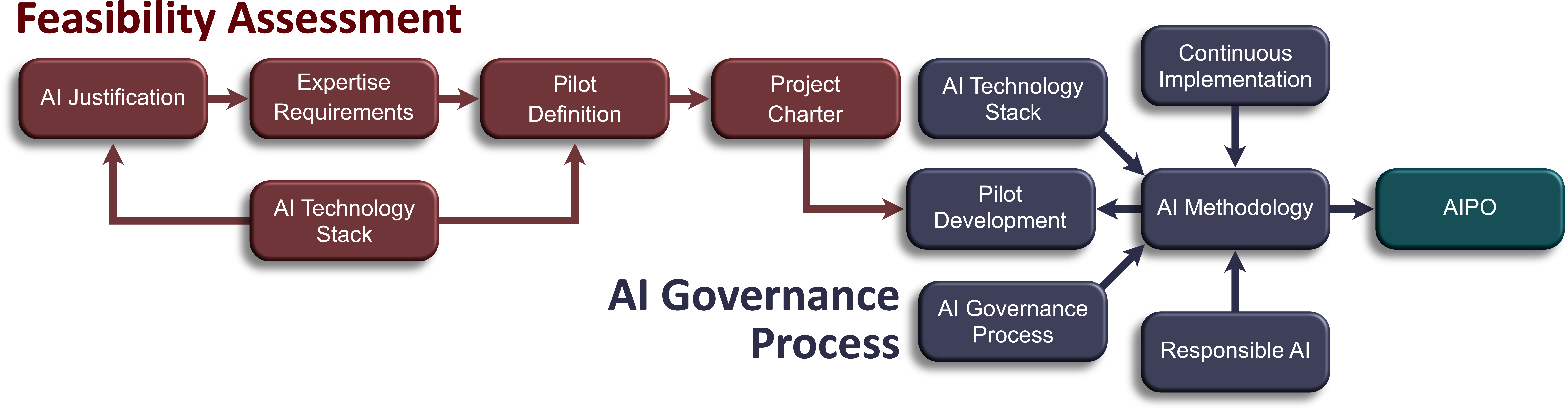
For successful AI delivery, it is crucial to adopt a structured approach that ensures business objectives are met, in accordance with ethical and regulatory requirements.
Framework
Compiled from best practices from several frameworks like CRISP-DM (structured lifecycle), TDSP (team collaboration and production readiness), CD4ML (MLOps and continuous delivery), Agile (iteration and adaptability), and Design Thinking (human problem framing), and CPMAI™.
Vendor-neutral and highly flexible and adaptable to organizations of all sizes, while being particularly well-suited for large enterprises.
Lean Principle
Deliver value and stability early by applying Lean principles to AI framework implementation.
Focus on what is essential to generate impact quickly, tailored to the enterprise context, capacity, and objectives, while iteratively maturing the process over time.
Implementing a lean framework as a first iteration, reduces the learning curve, and increases early adoption.
Embedded Ethics
Responsible AI is no longer optional; it is essential for building trust, mitigating risk, and delivering AI solutions that are ethical, safe, and effective.
As AI becomes increasingly integrated into society, Responsible AI is evolving from a best practice to a core requirement for adoption.
With current and upcoming global laws and regulations, organizations face growing pressure to embed Responsible AI throughout their solutions.
Iterative & Adaptive
Aligned with Lean principles and Just Enough Governance (JEG), continuous improvement is planned and built into the framework life-cycle.
Built on a strong foundation, the framework evolves organically with the team and the organization, ensuring processes remain aligned with advancing technologies and changing business needs.
This overall approach favours adaptability, enables early value realization, and reduces risk.
Practical Approach
The AI framework implementation is grounded in real-world organizational context, ensuring practical applicability beyond theoretical models.
It establishes a foundation aligned with the organization’s core objectives and capacity, incorporating a pilot AI initiative to validate the implementation and deliver value in its first iteration.
Applying Lean principles to the framework focuses efforts on activities that deliver quick results.